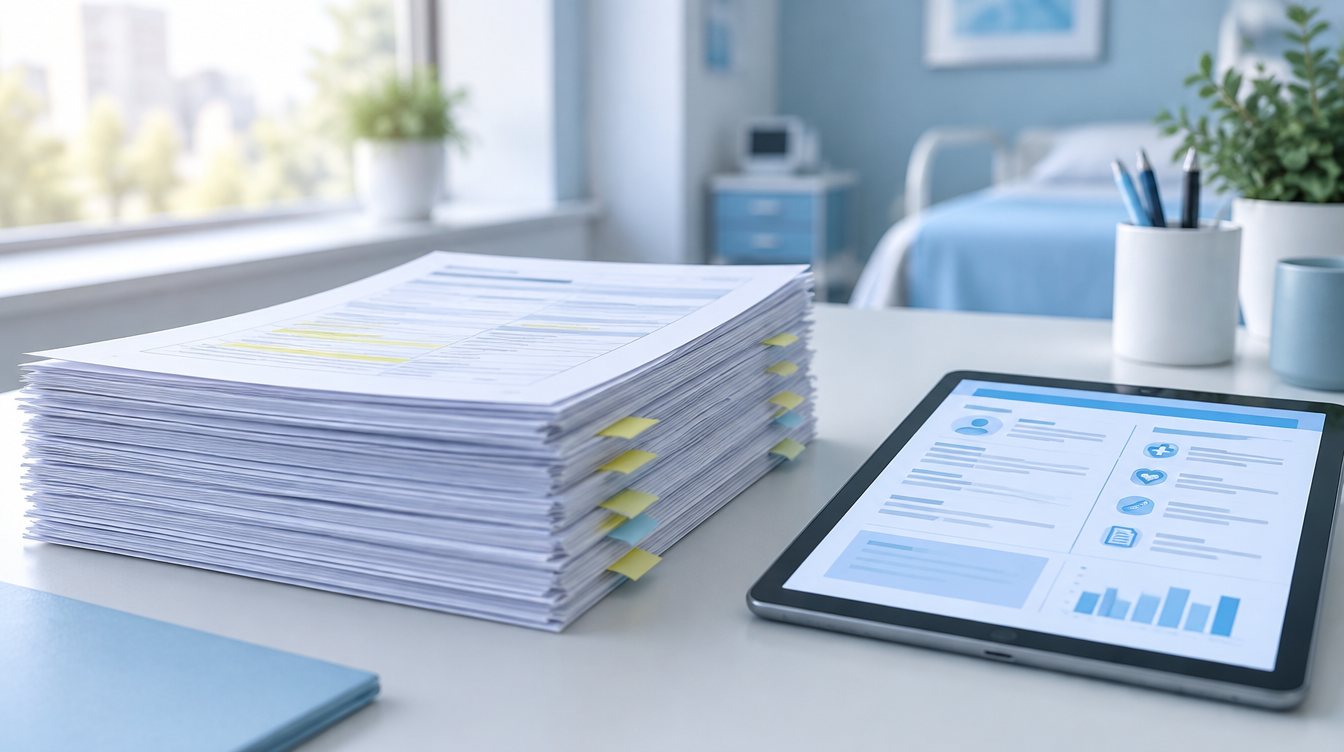
Hospital referral packets often run 150 to 300 pages. Read for risk first: code status, medications, allergies and isolation, oxygen, wounds, swallow, falls, cognition, devices and pending results. AI summaries can cut packet review time sharply, but only summaries that cite the source page for every statement are safe to rely on clinically.
A hospital referral packet for one new admission can run 150 to 300 pages.1 It arrives as a mix of discharge summaries, progress notes, medication lists, therapy evaluations, lab results and scanned forms, usually in no particular order. Somewhere inside it is the one line that changes how the first shift goes: an oxygen need on exertion, a new anticoagulant, a pressure injury, a swallow precaution.
This guide covers what matters most in a referral packet, a practical order for reading it, and how cited AI summaries are changing admissions and the first shift.
Why are referral packets so hard to review?
Volume is only part of it. Packets are built for the hospital's records, not for the nurse who has to care for the resident tonight. Research on hospital-to-SNF transitions has repeatedly found communication barriers between sending and receiving providers, including differences in access to information.3 And only about 55% of hospitals can electronically find, send, receive and integrate patient information, so much of it still arrives as scanned pages.2
Meanwhile acuity keeps climbing. Average comorbidities rose from 3.4 to nearly 5 per patient between 2019 and 2024.2 More conditions means more pages, and more places for something important to hide.
What should a nurse look for first in a hospital referral packet?
Experienced admissions nurses read for risk first and history second. A practical first pass:
- Code status and advance directives. Confirm they match across documents.
- Discharge medication list. Reconcile it against the hospital MAR. Flag new anticoagulants, insulin, opioids and antibiotics with stop dates.
- Allergies and isolation needs. Including any multidrug-resistant organisms.
- Respiratory needs. Oxygen at rest or on exertion, flow rates, CPAP or BiPAP.
- Skin and wounds. Pressure injuries, surgical sites, dressing orders.
- Swallow and diet. Texture, liquid consistency and aspiration precautions.
- Mobility and fall risk. Weight-bearing status, therapy orders and recent falls.
- Cognition and behavior. Delirium during the stay, dementia, sitter or safety needs.
- Lines, drains and devices. PICC lines, catheters, drains and removal plans.
- Pending items. Lab results still outstanding and follow-up appointments.
What is the fastest order to read a referral packet?
- Discharge summary first. It frames the stay and should list the active problems.
- Medication reconciliation next. Compare the discharge list with the last days of the MAR.
- Most recent nursing and therapy notes. They show how the patient is actually doing now, not on admission.
- Search, don't scroll. Look for high-risk terms: oxygen, fall, wound, isolation, NPO, anticoagulant, DNR.
- Write down what you couldn't confirm. Those are the questions for the hospital before transfer.
How do AI summaries change referral review?
AI can now read an entire packet and produce a short summary organized around the checklist above. In one reported example, packets of 150 to 300 pages were condensed to about 30, and referral review time fell from roughly 25 minutes to 10.1
Speed alone is not enough for clinical use. The summary has to be verifiable. The standard to hold any tool to: every statement links to the page it came from, so a nurse can check "oxygen on exertion" against page 17 in one click instead of trusting a paraphrase.
Why this matters for the first shift, not just admissions
Admissions teams read packets to decide yes or no. The floor nurse reads them to keep the resident safe tonight, often with five other residents on the assignment. When the packet's key facts carry forward into the shift handoff, with their sources attached, the incoming nurse starts the shift knowing what the admissions team knew.
That is what ChartRail does: a private AI reads the referral packets and nursing notes before the shift, and hands each nurse what changed, with every line traced to its source page.
Frequently asked questions
How long is a hospital referral packet for a skilled nursing facility?
Referral packets commonly run 150 to 300 pages, combining discharge summaries, notes, medication records, therapy evaluations, labs and scanned forms.
What should a nurse review first in a referral packet?
Code status, the discharge medication list, allergies and isolation needs, oxygen needs, wounds, swallow and diet orders, fall risk, cognition, lines and devices, and any pending results.
How fast do SNFs need to respond to hospital referrals?
Fast. Hospitals send an average of about 6.6 referrals per patient, so facilities that review and respond quickly are more likely to win the admission.
Can AI summarize hospital referral packets accurately?
AI can condense packets dramatically, but clinical use requires summaries that link every statement to its source page so nurses can verify it.
What is a cited AI summary?
A summary in which each statement includes a link or reference to the exact page of the source document it came from, so a reader can check it.
Book a 30-minute demo with our founders, or ask about our design partner program.
Book a demo- Skilled Nursing News, From 300-page packets to 30 (July 2026)
- Skilled Nursing News, Hospital to skilled nursing facility referral rate stable, admission rate rises (Dec 2025)
- Britton MC, et al. Care Transitions Between Hospitals and Skilled Nursing Facilities: Perspectives of Sending and Receiving Providers. Jt Comm J Qual Patient Saf. 2017