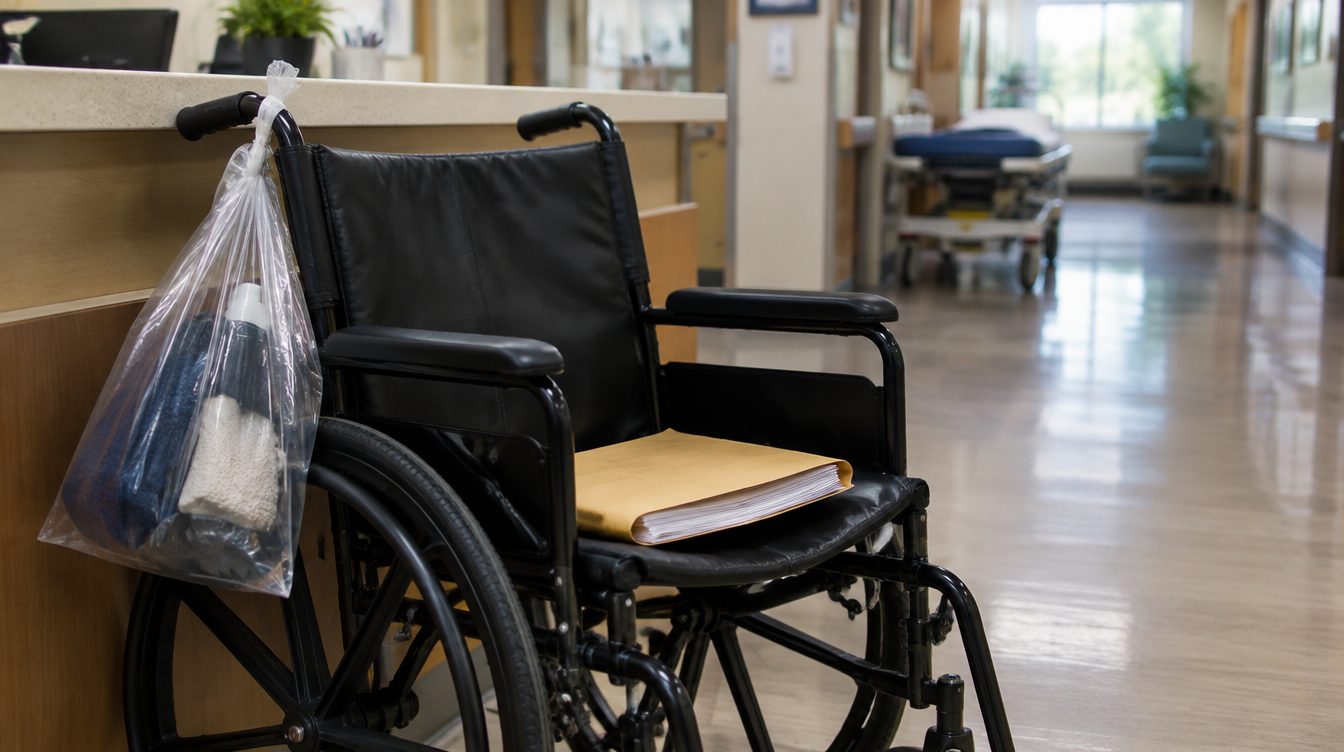
Hospitals are required to send a skilled nursing facility all necessary medical information when a patient transfers, but nothing defines what "necessary" looks like on arrival. What usually arrives is a large packet, not a handoff. Admissions nurses should check nine things on every new arrival, starting with why each line, device and medication is there.
The Joint Commission's alert on hand-off failures opens its case example in a rehabilitation unit. A young patient arrives from another facility, alone, with a pain pump and a urinary catheter. He becomes confused and agitated, and the admitting nurse struggles through the assessment because nobody told her why he had the pump, why he had the catheter, or why no family came with him.1
Anyone who has worked admissions in skilled nursing knows that scene. The patient is here. The paperwork is here. The answer to the question you actually have is somewhere inside it, or nowhere.
What does the hospital have to send?
Under Medicare's discharge planning rules, a hospital must send the receiving post-acute provider all necessary medical information about the patient's current illness and treatment, along with the patient's goals of care and treatment preferences.2 That is a real requirement, and most hospitals meet it on paper.
The gap is in the word necessary. The rule sets what must travel, not how it must be organized. So what arrives is often the whole record: discharge summary, history and physical, nursing notes, therapy notes, medication administration records and labs. A single referral packet can run 300 pages.3 Everything the admissions nurse needs is usually in there. Finding it before the patient needs it is the hard part.
What should an admissions nurse check on every arrival?
The Joint Commission lists the critical content every hand-off should carry.1 Translated to the moment a resident comes through the door, it becomes a nine-point check:
- Who to call. The name and direct number of someone at the hospital who knew this patient, not the main switchboard.
- Why each line, device and drain is there. Catheters, pumps, PICC lines, oxygen and wound vacs, each with its reason and its stop or review date.
- Medication changes during the stay. What was started, stopped or changed, and the time of the last dose of anything critical.
- Allergies. Confirmed against the hospital list, not just carried over from an old face sheet.
- Code status and goals of care. Including the treatment preferences the hospital is required to send.2
- The hospital course in plain words. What happened, what was ruled out, and what the team was worried about.
- Dated labs and vital signs. The trend, with dates, so you know what normal looked like for this patient.
- Pending results. Tests sent before discharge whose results haven't come back, and who will follow them up.
- What to watch in the first 72 hours. The contingency plan: what would send this patient back, and what to do first.
If any of these can't be found in the packet within a few minutes, that's the call to make before the shift changes, not after.
Why do these items go missing?
- The packet is organized for the hospital, not for you. It follows the order things were documented, not the order a receiving nurse needs them.
- Reasons are rarely written next to things. A catheter shows up in a nursing note. Why it was placed shows up, if at all, in a physician note forty pages earlier.
- Timing works against everyone. Transfers often land late in the day, when the admitting nurse also has a full assignment and the hospital team who knew the patient has gone home.
How can AI help with hospital-to-SNF handoff?
This is the problem ChartRail is built for. A private language model running in the facility, or in its private cloud, can read the whole referral packet as soon as it arrives and pull out the nine items above, each with the page it came from. Just as important, it can say plainly when something is not in the packet, so the nurse knows which call to make. The nurse still reviews and decides. The difference is that the review starts from an organized handoff instead of a stack. For the full reading strategy, see how to read a 300-page referral packet in minutes.
Frequently asked questions
What information must a hospital send to a skilled nursing facility at discharge?
Under Medicare's discharge planning rules (42 CFR 482.43), the hospital must send all necessary medical information about the patient's current illness and treatment, along with post-discharge goals of care and treatment preferences, to the receiving post-acute provider.
What is most often missing in a hospital-to-SNF handoff?
Common gaps include the reason for each line or device, recent medication changes and last dose times, pending test results, a direct contact at the hospital, and a clear plan for what to watch in the first days.
What should a SNF admission handoff checklist include?
Who to call, why each line and device is there, medication changes, allergies, code status and goals of care, the hospital course, dated labs and vitals, pending results, and what to watch in the first 72 hours.
Can AI help skilled nursing admissions review referral packets?
Yes. A private AI model can read the full packet, extract the key admission items with the source page for each, and flag items that are missing so staff know what to ask the hospital.
Book a 30-minute demo with our founders, or ask about our design partner program.
Book a demo